







Here are two perspectives on the impact of tall buildings on London’s heritage, summarising presentations given at an open meeting of LAMAS’s Historic Buildings and Conservation Committee (HBCC). The views are those of the authors, not necessarily those of HBCC.
The view from Richmond – by John Ricketts
It has been ten years now since New London Architecture, the independent membership organisation for London’s built environment sector, produced their landmark survey of the tall buildings (436) that were in the pipeline for London in 2015. The issue of the impact of such buildings on their surrounding streetscapes and heritage remains highly pertinent across the capital.
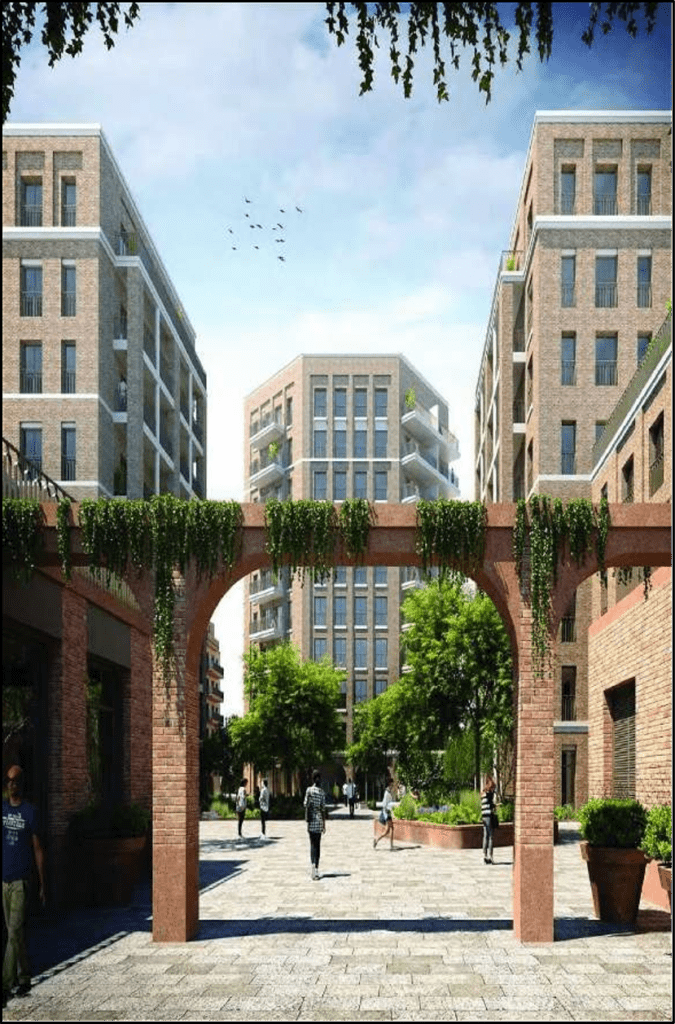
What is the definition of a tall building? Actually, it remains undefined in national policy (the NPPF https://www.gov.uk/government/publications/national-planning-policy-framework–2), and definitions in Local Plans (LPs) vary. The London Plan (Policy D9) states that “tall buildings should only be developed in locations that are identified as suitable” in boroughs’ LPs, a stipulation which itself was inserted on the direction of the Secretary of State. An example in the London Borough of Richmond (the Homebase, Manor Road site) illustrates the Mayor of London riding roughshod over the Borough’s plans to restrict tall buildings to appropriate areas. The Borough’s Local Plan (in draft stage at that time but in force since October this year) stated that tall buildings – now defined by the Borough as seven storeys or over – should be restricted to Tall Building Zones (TBZs) as defined in the LP. The Homebase site is in a TBZ which the LP specifies as suitable for heights of up to eight storeys, to respect the small scale of the surrounding area and heritage assets.
In May 2024, and in the face of considerable local opposition, the Mayor finally approved an application for a dense array of buildings of up to 11 storeys on the Homebase site, on the grounds that other requirements of the London Plan, specifically the need for more residential units, trumped the Borough’s tall building restrictions. The application had been refused by the Borough in 2019 on the grounds inter alia of the adverse visual impact of the tall buildings. Requests by local campaigners for the Secretary of State to call the application in, particularly in light of his direction that “tall buildings should only be developed in locations that are identified as suitable” in Local Plans, were refused with no reason given, despite the fact that a similarly large scale scheme nearby (the Tesco and Homebase sites in Syon Lane, Hounslow) was called in by the Secretary of State.
The application is now being superseded by a new scheme reconfigured in the light of financial viability concerns given the economic climate, but the maximum building height is still 10 storeys, 25% above the limit stipulated in the Local Plan. What price local democracy?
The view from the City – by John Schofield
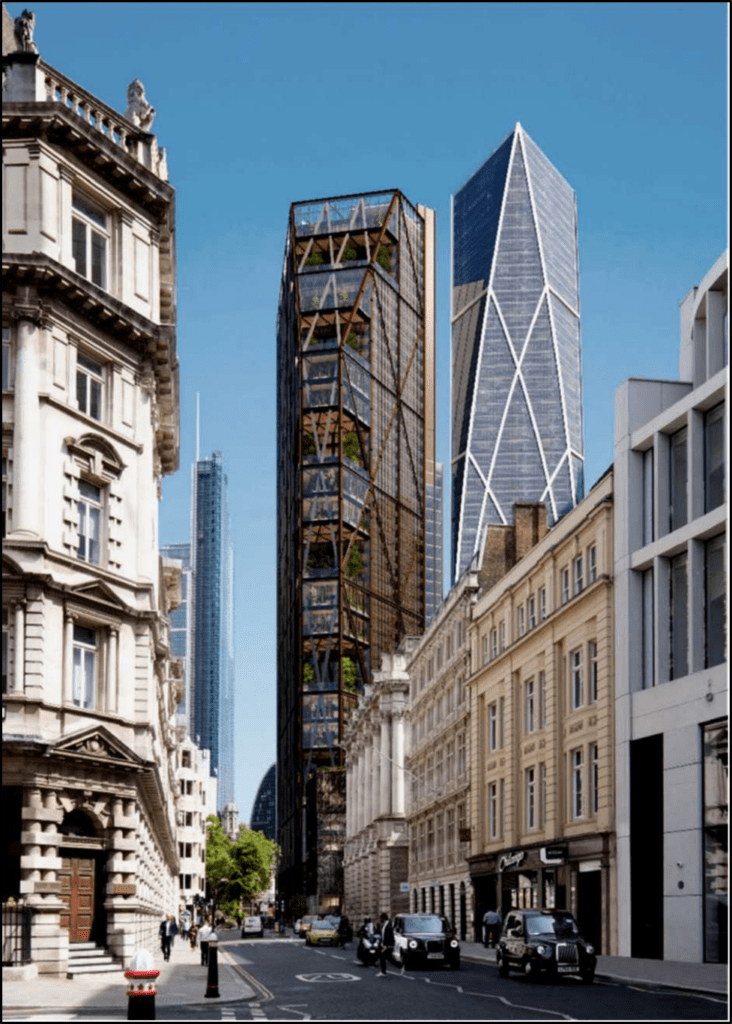
Image: RSHP Architects.
There are two areas in the City where tall buildings are allowed and encouraged: the first in Bishopsgate and Cornhill, the second a smaller area around Holborn. Tall buildings in the City are defined as those which reach above 75m above Ordnance Datum or sea level; so that is not 75m above ground level where the building is. Gracechurch Street is at about 17m above Ordnance Datum. The general grouping of the cluster is a bit of a mess. It is not Chicago, which in many ways is a model of how tall buildings can be accommodated, and indeed enhance a skyline.
The City Cluster of tall buildings around Bishopsgate is straining at its boundaries and pushing out. The Corporation in its own policy paper says ‘important views of St Paul’s Cathedral must be protected and enhanced’ – but the now consented tower at 99 Bishopsgate (on the left in the photo) removes precious space from around the cathedral’s dome when viewed from the west. Objectors (Historic England and the Surveyor of the Cathedral, Sir Christopher Wren’s successor) say the new building will cause significant harm to the heritage significance of a Grade I listed building, the Cathedral. The developer has not produced any detailed views of how the building would stand behind St Paul’s, which is probably significant and certainly rings alarm bells.
The building at 99 Bishopsgate will be 236m high; the Shard is 303m. The design itself is quite good. There is a lot of public space to be set up around its base. But there are no heritage benefits. It might be acceptable on another site; here, it is just in the wrong place. 55 Bishopsgate, the block’s neighbour to the south (on the right in the photo), was already consented, over the objections of Historic England, the Cathedral and others. These blocks are intrusions. They disrupt with their scale and siting. And tall buildings are sprouting outside the areas allocated for them: for instance in Whitechapel.
In the case of tall buildings, we are contending not only with developers or the owners of sites, but with planners. We have to criticise and influence the planners. Tall buildings may be necessary for the future of the City of London, as they bring jobs and taxes, but they have to do more in respecting the previous built heritage around them. Our economic future and our history need not be at odds. What can LAMAS do? We need to make sure tall buildings are a positive contribution to the townscape and not a negative one. We can read carefully the views of bodies like St Paul’s and Historic England when they object and possibly add our support to their objections. We need to consider strategic views of the City skyline and its major monuments.
This article first appeared in the January 2026 LAMAS Newsletter. If this article stirs any indignation and wish to contribute to the work by LAMAS in conservation all over London, consider becoming a member of the Historic Buildings and Conservation Committee – see further details on this web page: https://www.lamas.org.uk/historic-buildings-committee/ You need only to cover your borough. The work is very interesting and worthwhile.