






Anne Mowbray: the Princess in the Police Station and the Princes in the Tower
Did you know that in December 1964 when the small lead coffin containing the Anne Mowbray,
Fig 1. Cutting from the Evening News 11/12/64.
a Plantagenet princess was discovered by workmen, it ended up in Leman Street Police Station? Earlier that day workmen excavating new foundations on the site of the church of the Abbey of St Clare in Tower Hamlets had discovered a burial vault, which they broke into and then extracted Anne’s anthropomorphic lead coffin. Next, they telephoned the press and then they posed for photographs with the coffin (see Fig 1).
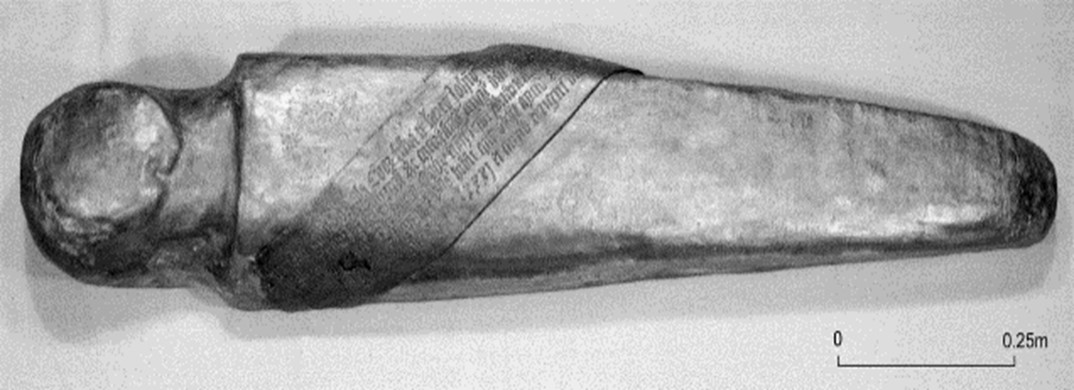
Later the same day the workmen handed the coffin over to the police, who suspected that it was historic, so they gave it to Dr Francis Celoria, Field Officer of the London Museum, who took it away in the back of his Land Rover (see LAMAS Trans 69, 2018, p. xiii for a tribute to Celoria’s contribution to London archaeology). Celoria realized from the Latin inscription that the coffin contained the remains of the eight-year-old Anne Mowbray, the Duchess of York, who had died in 1481 (Fig 2). She was the child bride of Richard, Duke of York (the younger son of Edward IV).
Fig 2. Anne Mowbray’s lead coffin (1.43m long), notice the Latin inscription on the plaque wrapped around the top half (© Museum of London).
Celoria realized that this was very rare opportunity to carry out a scientific study of a named medieval individual (see LAMAS Trans 67, 2015, p. 227-60 for further details about Anne’s burial and its analysis).
Anne Mowbray was the only child and heir of John (VII) Mowbray, fourth Duke of Norfolk (died 1476). Edward IV decided that as Anne was extremely rich that she should marry his younger son Richard, to enrich his own family. A papal dispensation was required for the marriage as Richard was aged four and Anne only five, so they were far too young to legally marry and they were also distant cousins. The two young children were married on the 15 January 1478 in St Stephen’s Chapel in Westminster Palace. Anne’s marriage was imagined by James Northcote in1821 in a dramatic ‘history’ painting (Fig 3). Anne died in November 1481, shortly before her ninth birthday.
Fig 3. The marriage of Richard of Shrewsbury, Duke of York to Lady Anne Mowbray, by James Northcote RA (© Royal Collection).
Her cause of death is not documented and her skeletal remains showed no sign of disease. Interestingly, analysis of her hair revealed that some of her roots were atrophied, generally this is a sign ill-health (ditto LAMAS Trans 67, p. 243; Fig 4).
Fig 4. Anne Mowbray’s shoulder length hair (© Museum of London).
There was no body tissue present and generally very poor organic preservation inside Anne’s coffin (with the exception of her hair) as it had been punctured centuries before it was discovered (perhaps when it was moved in c.1502, see below). Anne was initially buried inside Westminster Abbey, but in 1502-03 when this part of the abbey was demolished to make space for Henry VII’s new mausoleum, it is believed that her remains were relocated to the church of the Abbey of St Clare, where her mother Elizabeth (died in 1506) was then living.
The discovery of Anne’s remains in 1964 created huge interest in the press (Fig 1), which can be compared with the coverage of the 2012 discovery of the remains of Richard III in Leicester -‘the king in the car park’ (ditto p. 251 – appendix). Unfortunately, Celoria’s planned programme of analytical work on Anne’s burial was curtailed by legal issues, but despite these difficulties studies of her coffin, skeletal remains, teeth and hair were undertaken (ditto p. 239-45). A facial reconstruction of Anne using existing data was produced in 2016 by Amy Thornton of Dundee University (Fig 5).
Fig 5. The facial reconstruction of Anne Mowbray (reproduced by kind permission of the late John Ashdown-Hill).
In 1965 Anne’s remains were reburied in the Duke of Buckingham’s Chapel (situated at the east end of Henry VII’s mausoleum) Westminster Abbey.
The Fate of Anne’s Husband – the younger of the Princes in the Tower
The unexpected death of Edward IV in April 1483, created a crisis as his older son who was proclaimed Edward V was only aged 12. Therefore, Edward IV’s younger brother Richard, Duke of Gloucester assumed the role as Protector. Things started to go wrong when it was claimed that Edward IV’s clandestine marriage in 1464 to the widow Elizabeth Grey (née Woodville) was bigamous due to a pre-existing marriage contract and therefore their children were illegitimate and consequently barred from the throne. Richard used his position as Protector to make himself king in June 1483
having persuaded parliament that his nephews were illegitimate, which avoided proper legal scrutiny of the allegations. However, Richard III realised that the disinherited Edward V and his younger brother Richard, Duke of York were still a threat to his regime, so he imprisoned them in the Tower of London. In July it is believed there was an attempt to rescue the two princes from the Tower. It has been suggested that this failed conspiracy encouraged Richard III to have the boys murdered. By 1484 it was rumoured that the ‘Princes in the Tower’ had been murdered by their uncle.
The fate of the two princes has been the subject of much speculation and the discovery in 1674 within the Tower of London of the partial skeletons of two juveniles is often interpreted as the remains of the two missing princes, but this has never been proved. In 1678 on the orders of Charles I the remains of these two juveniles were reburied as royalty in Westminster Abbey. In 1933 their teeth and skeletal remains were examined, indicating that these two individuals are about the right age to be the two missing princes (ditto p. 234). In the 1980s the published dental and osteological data was reassessed by Theya Molleson confirming that these two individuals are about the right age to be the two princes (see London Archaeologist 5, 1987, p. 258-62). However, the 1933 osteological examination of two juveniles was unsatisfactory by modern standards. For instance, their gender was not established. A modern osteological examination is needed to confirm their age and gender and it also should include the radiocarbon dating of each skeleton (to establish their antiquity) and the extraction of the mitochondrial DNA to confirm if they really are the missing princes (as if they are then their Y chromosome will be identical to that of Richard III as they are descended from the same paternal line).
In 2023 Philippa Langley (who started the search for Richard III’s grave) published a book entitled The Princes in the Tower: solving history’s greatest cold case. She argues that in 1483 Edward V and his brother Richard escaped from captivity in the Tower and went aboard. Subsequently they both made unsuccessful comebacks as the ‘pretenders’. She argues that Henry VII to discredit these rivals for the throne claimed they were Lambert Simnel and Perkin Warbeck, something that other historians dispute (see the review of her book in LAMAS Trans 74, 2023, p. 387).
Since Philippa’s attempt to exonerate Richard III of the murder of his nephews was published, a new piece of damming evidence has been published by Professor Tim Thornton (see ‘Sir William Capell and a royal chain: and the afterlives (and death ) of King Edward V’ History (2024) 109, issue 388,p. 445-60, available online via Wiley library). He discovered that listed in Lady
Margaret Cappel’s will of 1522 is a chain of office or state that had belonged to Edward V. This chain is the only surviving evidence for any of Edward V’s personal possessions. Perhaps the Cappell family obtained this chain from Sir James Tyrell, a brother-in-law of Lady Margaret’s husband. Tyrell was named by Sir Thomas More in his History of King Richard III (written in c.1513-20) as the person who organized the murder of the princes on the orders of Richard III. Traditionally More’s history has been dismissed as Tudor propaganda intended to discredit Richard III, but Professor Thornton has argued that as there is considerable evidence concerning the careers in royal service of Tyrell and his two associates John Dighton and Miles Forest that More’s account of the murder of the princes is plausible. (See ‘More on a Murder: The Deaths of the ‘Princes in the Tower’, and Historiographical Implications for the Regimes of Henry VII and Henry VIII’ History (2021) 106, issue 369, p. 4-25, available online via Open Access). According to More’s account (which was dramatized by Shakespeare in Richard III) Dighton and Miles one night smothered the two princes in their beds and then buried their bodies nearby ‘at the stair-foot’ (Fig 6).
Fig 6. An 18th-century engraving depicting the murder of the sleeping princes (© Creative Commons).
More believed that the Constable of the Tower’s priest subsequently had their remains reinterred in a secret location. More’s description of the initial burial place of the princes closely matches the spot inside the Inmost Ward of the Tower where the skeletal remains of two juveniles were discovered in 1674. It seems that the only way that the identification of these two juveniles as the missing princes can be either proven or disproven is by their scientific study (see above). As Westminster Abbey is a royal church, any analytical work on the ex-situ remains of the two juveniles would have to be approved by the sovereign. The late queen turned down a number of requests for analytical work. However, Charles III apparently is prepared to support a new analytical programme (see ‘King “backs DNA test” to end mystery’ Times 15/10/22 p. 23). Watch this website and the LAMAS Newsletter for updates on this medieval mystery.
Read More

The search for Jewish food in London’s medieval Jewry
An analysis of the animal bones from 10th to 13th century pits at Milk Street (MKL76)
John Schofield and Rebecca Gordon
In 1976–7, the Department of Urban Archaeology of the Museum of London carried out excavations at 1–6 Milk Street, EC2 (site MLK76) which revealed several medieval properties and 121 pits and from the late 9th century to the 13th century. The pits contained a wide array of archaeological finds including pottery, leather shoes, wooden bowls, metal and bone objects, textiles (linen, cloth and silk) and animal bones. The details of the excavation were published in Transactions 41 (Schofield et al 1990).
In December 2019, LAMAS granted John Schofield and Rebecca Gordon £3,500 to publish all the medieval faunal collection from the Milk Street excavation to follow and match the original report of 1990. Rebecca has analysed the animal bones from one of the most important pits, Pit 81 (on the plan, Fig 1; what it looked like, Fig 2) on a grant from the City of London Archaeological Trust (CoLAT). It was evident that she should continue with the analysis of all the animal bones from the 121 pits.
There are two objectives: to study the animal bones in the pits, to observe characteristics and changes in human diet; and to see if we can identify Jewish food practices (sometimes called foodways).
Milk Street is within the heart of London’s medieval Jewry, north of Cheapside. Jews had taken residence in this area by the 12th century. The boundary of the London Jewry was never fixed and Jews and Christians coexisted within it until the expulsion of the Jews in 1290. Three tenements discovered in the 1976–7 excavation were occupied by Jewish families in the 13th century and possibly before (Schofield et al 1990, 131–44). After the excavation and during the redevelopment of the building constructed on the site in 1978, a mikveh or Jewish ritual bath was discovered which belonged to one of the Jewish families on the street (Blair et al 2001; its position is shown on Fig 1). This had survived, just outside the area excavated in 1976–7.
Archaeological evidence for London’s Jewish community has been sparse and the recovery of Jewish material culture from the City has been sporadic. Surprisingly, the potential of faunal remains to detect Jewish dietary practices remains to be fully explored using assemblages excavated in London. Analysis of faunal remains from European medieval sites with Jewish populations have shown how animal bones can be a useful indicator for Jewish occupation. This is because the slaughter, preparation and consumption of meat must adhere to the laws of kashrut to be considered as kosher (fit for Jewish consumption) which includes the exclusion of, for example pork, rabbit, horse, eel, shellfish and hindlimbs of the main domesticates (unless the latter have been processed by a kosher butcher).
The LAMAS grant will allow us to determine what Jewish and Christian Londoners ate in the 9th to 13th centuries, and the analysis will note the bones of fish (figure 3), pets, vermin, and exotic species.
The recording of the bones will be undertaken by Dr Rebecca Gordon. She completed her PhD in zooarchaeology at the School of Archaeology and Ancient History, University of Leicester in 2015, and is currently a freelance zooarchaeologist and independent researcher.
John Schofield will provide the wider context for the study; he was the original site supervisor for this part of the sequence (the post-Roman) on the 1976–7 excavation
Read More

“Face of a Plantagenet child bride” : LAMAS in the Sunday Times
Face of a Plantagenet child bride
Norman Hammond, Archaeology Correspondent. The Times.
The 67th volume of the LAMAS Transactions (2016) features a piece by Bruce Watson and William White on the child princess, Lady Anne Mowbray, married into the House of York at the apex of the Wars of the Roses at just the age of eight, and whose skeleton was found in the ’60s beneath the street of Minories in East London. The article examines past and present knowledge on the child’s skeletal remains, and its findings were picked up by The Times (published in print on November 25th 2017). Read it on The Times Online, or check it out below!
Read it in the Transactions: “Anne Mowbray, Duchess of York: a 15th-century child burial from the Abbey of St Clare, of St Clare, in the London Borough of Tower Hamlets”. Bruce Watson and William White. London & Middlesex Archaeological Society, Vol 67, pp. 227 – 260.
The face of a Plantagenet princess has been reconstructed from her skeleton, while her bones and hair have yielded data on her stature and health at the time of her death in 1481. The remains of Lady Anne Mowbray also have the potential to illuminate one of English history’s greatest mysteries: the fate of the Princes in the Tower. Lady Anne was the daughter of the Duke of Norfolk, his only child and, after his death in 1476, the greatest heiress in England. Edward IV got papal leave to have her married to his younger son, Richard, Duke of York, in 1478, although she was related to the Plantagenets and both were legally too young to marry. However, Anne died before her ninth birthday, leaving Richard a widower at the age of eight. Interred in Westminster Abbey, she was later ejected by Henry VII in 1502 when he built his own mortuary chapel at the eastern end. Her coffin was then reburied in St Clare’s Abbey near Aldgate, the home of her mother, the dowager duchess of Norfolk.
In 1964 a digging machine uncovered her vault while clearing wartime bomb damage, as Bruce Watson reports in Transactions of the London and Middlesex Archaeological Society. Dr Francis Celoria of the London Museum (now the Museum of London) realised from the finely engraved plate on the lead coffin who was inside it and set up a multidisciplinary scientific investigation to study her remains. A fuss in parliament and in the press about the failure to obtain a burial licence curtailed the study, and its results have never been fully published. They do, however, show that she was about 4ft 4in tall — small for a modern child of nine, but the norm until the late 19th century due to deficiencies in diet. Her hair had high levels of arsenic and antimony, perhaps from her medicines, and she seems to have suffered from ill-health. When her body was prepared for burial her shroud appears to have been treated with beeswax and decorated with gold leaf or thread, and a separate cloth covered her face.
“Individuals like Anne who are precisely dated are vital, so her remains are of international importance. A recent survey of more than 4,600 juvenile burials from 95 British medieval and early post-medieval sites included no named individuals”, so their precise dates of birth and death could not be ascertained, Mr Watson notes.
Of more general interest was a congenital dental anomaly — missing upper and lower permanent second molars on the left side — that Lady Anne shared with the two juvenile skeletons found in the Tower of London in 1674, assumed to be those of her husband, Richard Duke of York, and his brother, King Edward V (the Princes in the Tower). The bones, which are interred in a splendid marble urn in Westminster Abbey, have not been examined since 1933, but reanalysis of photographs has suggested that the two juveniles were 13½-14½ and 11½-12½ years old when they died. If they were indeed the bones of Edward V and his brother, then the overlapping spans show that they could have died in 1484, pinning the blame on their uncle, King Richard III (The Times, May 21, 1987). A slightly later date in the reign of Henry VII is also possible, Mr Watson says, but “the debate over the identity of these undated juveniles will continue until their remains are re-examined. They could be radiocarbon dated and DNA extracted to confirm if they are related to each other and to Richard III.”
Since Richard’s skeleton was discovered five years ago and intensively studied before his reburial in 2015, his DNA is available and a link through the male Plantagenet line could be established, Mr Watson notes. Despite many suggestions in recent decades that the putative remains of the Princes in the Tower should be subjected to the minimal sampling needed using modern technology, the authorities at Westminster Abbey (a “Royal Peculiar” outside the Church of England’s control) have resisted.
“It is extremely rare for the remains of named pre-Reformation individuals to be studied in England,” Mr Watson says. Richard III’s rapid interment without perhaps even a shroud was “completely untypical and can be attributed to the unexpected manner of his death”. Anne Mowbray’s burial was that of an aristocrat with royal links and “undoubtedly of value to our understanding of death and burial during the late 15th century”. The new reconstruction shows us how her princely bridegroom may have seen her.
Read More