






LAMAS has been offering a research fund since 2005 to assist individual members, and also affiliated societies, to undertake research projects furthering our knowledge of London’s history and archaeology. Here is a summary of the research projects and recipients that were successful this year:
London soup kitchens during the long nineteenth century, 1790-1914, Phil Carstairs
Soup kitchens were a vital resource for London’s poor during times of high food prices and high unemployment. Despite their prevalence and their importance to the poor’s survival, they are often poorly documented and little studied.
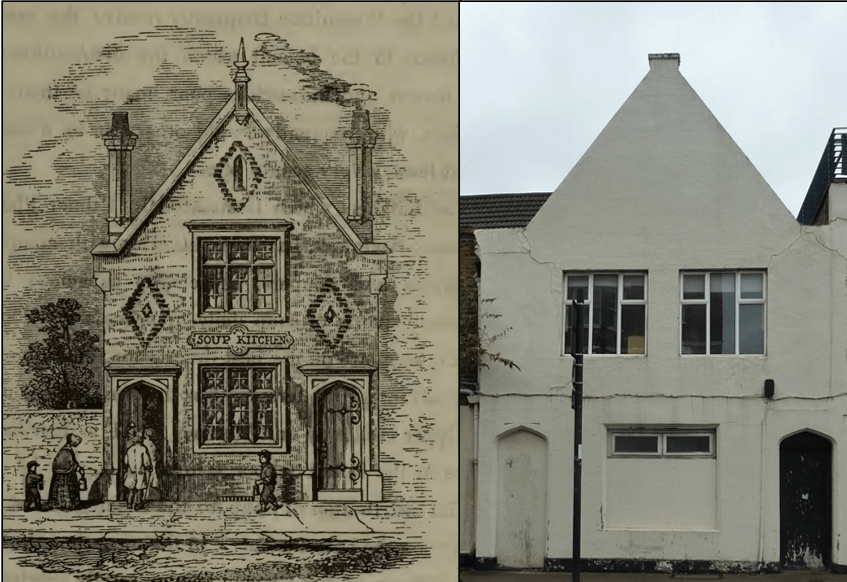
The project will identify those soup kitchens operating in north and east London during the nineteenth and early twentieth centuries, and locate these on Layers of London (a digital mapping service). A small sample (there will have been several hundred soup kitchens operating in this area if not more) will be subject to more detailed architectural/archaeological survey and study using evidence from the surviving buildings and documentary sources (where these survive). It is estimated that between 20 and 40 buildings that housed soup kitchens still survive in this area; the project has so far identified 15 buildings that once housed soup kitchens surviving. The majority of these survivors are former religious mission buildings although three buildings used by charities that were not affiliated to a particular church or religion have so far been identified.
Given the limited and self-serving nature of most of the documents left by the charities and missions, understanding the buildings and how they operated and where they were located in the landscape is vital to understanding what they were actually like and how they were experienced by the poor.
The outcome will hopefully show how the local communities that made up north and east London responded to hunger and poverty and how missions acted differently to charities. It will result in a publication in LAMAS Transactions and contribute to a book I am currently writing on nineteenth century soup kitchens.
Phil Carstairs will be conducting the research. Phil is an archaeologist and historian specialising in the post-medieval period with a particular interest in buildings.
Wish You Were Here: Local and Community Histories through Picture Postcards and Postcard Messages, John Price
The overall objective of this project is to digitise an extraordinary and extensive collection of picture postcards, and the written messages they contain, and to make the entire collection freely available online for researchers to use.
The Ken White Postcard Collection is comprised of 7,000 postcards. However, unlike many postcard collections, 4,200 (60%) of them have been posted and contain written messages. Ken White (1923-2012) was a prolific local historian, author, geographer, and environmentalist who donated many collections, including these postcards, to the Lewisham Local History Society.
An initial audit reveals that most of the written postcards date from between 1870 and 1960 and, more often than not, they were posted to addresses in Greater London. The postcard images are very broad and varied, but they include: British local and national landscapes and buildings; contemporary illustrations, cartoons, and sketches; messages relating to occasions such as birthdays and Christmas; and religious and cultural images and iconography. However, it is the messages and information on the reverse of the cards that make them significant and interesting, particularly for historians and researchers.
Collections of written postcards on this scale, outside the hands of commercial or private collectors, are very rare and unusual. The plan is to digitise all 7,000 postcards front and back. The collection is held by the Museum of Everyday Life, which is an online archive and museum that engages with the archive collection of the Lewisham Local History Society.
The project will be managed by Dr John Price, the Director of the Museum of Everyday Life, and the work will be undertaken by the experienced team at the museum.
Mr. Herbert William Brittan, his family and home, and their place in the local community, Adam Markiewicz
This research will provide an in-depth historical case study of the Brittan family at 20 Thurlby Road, West Norwood. It will include research on Mr. H.W. Brittan, who was an important local historical figure, and demonstrate the influence of him and his family to the history of the local area and community. It will also cover broader themes of social history, women’s history, and architectural history. Most significantly this project will take a people’s history approach utilising a unique set of sources in order to fully contextualise their lives and experiences and what that can tell us of historical importance.
Mr. Herbert William Brittan was described in the local press in 1949 as ‘The man who has done more for Norwood than any other living citizen’. What is immediately evident from preliminary research is that Mr. H. W. Brittan was a remarkable individual of multifaceted historical interest, who at the time was well-known in his community and even seen as somewhat of a local hero. Therefore, one objective of this project will be to compose a biography of Mr. H.W. Brittan, as he has thus far received no attention in research.
Preliminary research of just one of the Brittan daughters presents a fascinating case study of 20th-century women’s history, given the fact at the time of her studying at the London Medical School for Women there would have been less than 300 individuals enrolled. Therefore, a further objective of the project is to better illustrate Ruth Brittan’s biography, those of her mother and her sisters, and the Brittan family unit as a whole as they represent an interesting microcosm of several intersections of 20th-century local and social history. Given the house they lived in was of Mr. Brittan’s own design, research into the architecture of the house may also be of historical interest depending on sources available.
This project will promote the study of local history in the Greater London area primarily as a local history case study of the Norwood area.
Adam Markiewicz, freelance historian will be conducting the research.
The Supply Reserve Depot and its place in the community of First World War Deptford, Jude Pretoria
This project proposes to research the overlooked impact of the Supply Reserve Depot (SRD), Deptford.
Based in Deptford on the site of the former Foreign Cattle Market, nowadays the dormant Convoys Wharf, the SRD operated from the 1910s and was especially impactful during the First World War, where it functioned as the principal Army depot for reserve supplies of all kinds to be accumulated. This material ranged from foodstuffs of all sorts (sugar, flower, bacon, etc.), to rations, to tobacco and cigarettes, and even to the Princess Mary Gift Tins distributed to all fighting soldiers for Christmas 1914. To manage all this material the depot possessed a vast network of infrastructure with many yards, goods sheds, light railway tracks, and concrete landing stages that stretched from the shorefront into the river proper.
By virtue of its size, strategic importance, and employment of both military and civilian personnel, the SRD was an impactful part of Deptford and London’s landscape during the First World War. Its staff ranged from Army Service Corps personnel from across the country, to an increasingly large contingent of Women’s Auxiliary Army Corps labourers, to local civilian labourers and workers of various kinds. Thus, the SRD was a space familiar to both locals and non-locals alike. This brought further problems: much theft of government property occurred, and nearly every week Greenwich Police Court heard such cases. These were reported nearly non-stop in local newspapers for the duration of the war.
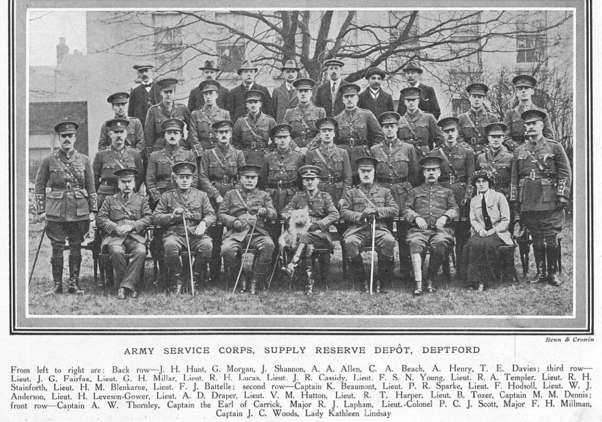
The SRD survived the war and continued to operate in the interwar period as well as the Second World War, however it seems to have had a diminishing role as the intricacies of logistics developed over time.
Despite standing in the lineage of well-known river-side industries that occupied this site in Deptford and despite its clear impact on the local community, the SRD has nonetheless thus far not been academically studied and written about. This project proposes to make use of the Research Fund to rebalance this, and bring light to this unique building, its social impact, and the physical remnants it leaves behind.
Jude Pretoria will be conducting this research. Jude is a recent History graduate set on pursuing a career in heritage studies.
Many projects involving a LAMAS research grant have been published in Transactions. A list of past recipients can be found here https://www.lamas.org.uk/wp-content/uploads/2025/08/Round_up-2005_2023.pdf.
We will announce when the fund is open for applications later this year.