






Description
The lecture will briefly summarise the results of Pre-Construct Archaeology (PCA) in around Bermondsey Square over 20 years from 1998 to 2018. The sites are not only significant in relation to the Cluniac priory and later Benedictine abbey of St Saviour, but the excavations also revealed evidence spanning the Iron Age to modern periods.
The site lies on land that formed the Bermondsey Eyot during the prehistoric period. A few pits and a small pottery assemblage attest to settlement during the Iron Age.
Evidence for the Roman period suggested a landscape predominantly given over to agriculture. However, in the later Roman period ,robber trenches, and significant amounts of ceramic building material including opus signinum suggest that substantial masonry buildings were extant to the north of Bermondsey Square in the area of Stevens Street.
Fragmentary wall foundations, of an east-west aligned building or series of buildings and associated small finds and coinage may be the first archaeological evidence for a middle Saxon minster at Bermondsey. By the 10th century a small apsidal church had been constructed with a small number of inhumations nearby.
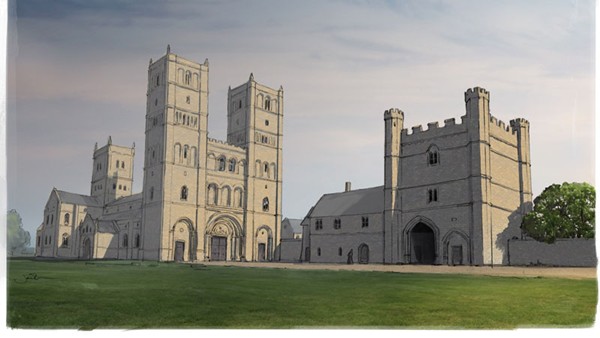
Perhaps the most significant aspect of the excavations at Bermondsey was the evidence of extensive medieval foundations that allowed us to undertake a detailed reconstruction of the Cluniac Priory and its subsequent development until the dissolution of the abbey in the 16th century.
In 1539 the site of the former monastery was acquired by Rober Southwell and later sold to Sir Thomas Pope, who built a large mansion. The excavations revealed Pope’s mansion as a grand double court-yard building with a separate range pf buildings to the east constructed I the 17th century.
A Presbyterian cemetery unearthed on the west side of Bermondsey Square was a graphic demonstration of the special character of Bermondsey as a stronghold for religious dissent
In the 18th Century King John’s court was developed for ‘artisan’ housing. The archaeological remains, topographic and documentary evidence dated to this period gave a fascinating in site into the social history of this part of Bermondsey.